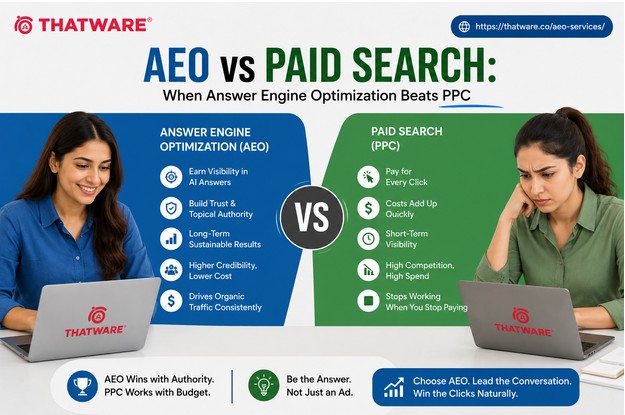
Paid search has a very appealing quality: it’s immediate. You turn it on, the ads run, the traffic shows up. There’s no waiting for domain authority to build or content to mature. You pay, you get visibility. The feedback loop is short and legible.
AEO is almost the opposite. It’s a slow build. You create structured content, you develop external authority, you build entity signals — and then, over weeks and months, you start showing up in AI-generated answers. There’s no switch to flip. The results accumulate gradually, and early on, they’re hard to measure.
Given that, why would any rational marketer choose AEO over PPC? The honest answer is complicated — and the right answer depends significantly on your specific situation. But for certain types of brands, in certain competitive contexts, AEO delivers returns that paid search fundamentally can’t match. Understanding when those conditions apply is the real question.
What PPC Actually Costs (In Full)
The traditional case for paid search rests on its controllability and immediacy. But when you look at the full economics, the picture is more complicated. CPCs in competitive B2B categories can be extraordinary — $30, $50, $100 per click is not unusual in software, legal, financial, or healthcare categories. And those clicks don’t convert into customers without conversion-optimized landing pages, nurture sequences, and sales capacity to follow up.
The math on paid search is increasingly challenging for many B2B companies. High CPCs, modest conversion rates, and long sales cycles can produce customer acquisition costs that are difficult to justify. The brands that are most enthusiastic about PPC economics are typically those in categories where CPCs are still reasonable — and those categories are getting rarer as competition intensifies.
AEO, by contrast, is a cost-to-build model rather than a cost-per-click model. You invest in creating the content and authority infrastructure, and then those assets generate AI answer visibility without ongoing per-click spend. The economics look bad early (all investment, no return) and increasingly good over time (ongoing returns without proportional ongoing spend).
Understanding AEO vs SEO and paid search as a portfolio decision — not a binary choice — is usually the most useful framing. The question is how to allocate resources across channels based on your timeline, your category’s competitive dynamics, and your tolerance for different kinds of risk.
Where AEO Decisively Beats PPC
There are specific situations where AEO is genuinely superior to paid search, and understanding them clarifies when to prioritize.
Research-phase queries. Paid search is best for high-intent, transaction-ready queries. “Buy project management software” — that’s a PPC query. “What should I look for in project management software for engineering teams?” — that’s a research-phase query that AI answers handle, and it’s almost impossible to efficiently target with paid search. But it’s exactly the AEO opportunity. Showing up as the authoritative answer to research-phase questions positions you earlier in the buyer journey, with potentially stronger brand preference by the time purchase intent develops.
Branded trust signals. When an AI recommends your brand or cites your expertise, it carries a different quality of trust than an ad. Users know ads are paid for. AI recommendations feel (and increasingly are) editorial. That trust differential has real effects on conversion rates and brand perception.
Compound returns over time. PPC stops the moment you stop paying. AEO authority, once built, continues generating returns. For brands with a long time horizon — which should be most brands — that compounding dynamic significantly changes the ROI calculus.
The Categories Where PPC Still Wins
Fairness requires acknowledging where paid search continues to outperform AEO, at least in the near term. For high-intent, ready-to-buy queries, PPC is still the most direct path to conversion. For brand launches that need immediate visibility, PPC provides the speed that AEO can’t. For highly seasonal or time-sensitive offers, the control and timing precision of paid search is genuinely valuable.
The smartest brands are not choosing between AEO and PPC — they’re running both, with PPC covering the high-intent bottom of the funnel and AEO building authority and trust at the top. The best Answer Engine Optimization agency will tell you exactly this: AEO doesn’t replace your paid search budget, but it can dramatically improve the efficiency of your entire acquisition funnel by generating warmer, better-informed prospects who have already encountered your brand through AI answers.
The Risk Profile Question
One more lens worth applying: risk. Paid search carries concentration risk. If CPCs in your category increase significantly (and they tend to over time), if your ad account gets flagged, if a platform changes its policies — your visibility disappears. AEO authority is more durable and distributed. It doesn’t depend on any single platform’s goodwill or pricing decisions.
For brands that have experienced the whiplash of major algorithm updates destroying organic search rankings, or major PPC cost increases squeezing margins, AEO offers a different kind of resilience. It’s not invulnerable — AI answer behaviors do change. But it’s typically more stable than channels where you’re renting visibility rather than earning it.
That’s the deepest reason to invest in AEO alongside paid search: it’s building an asset, not renting an audience. And in the long run, assets tend to be worth more.